
15 July 2026
Commercial Fire Alarm Systems in Bristol: Categories, Costs and What the Law Requires
Fire alarms are the one part of a commercial building people notice only when the weekly test goes off - and the one part that has to work perfectly the day it matters. For a Bristol business the stakes are legal as well as practical: faulty electrics remain one of the leading causes of fire in commercial buildings, and the responsible person for any premises carries a legal duty to detect and warn. Getting the system right is not about buying the most expensive panel on the market. It is about matching the category to the actual risk in your building, installing it to standard, and keeping it maintained. This guide explains the fire alarm categories in plain terms, which one different Bristol premises need, what the law expects, and what it all costs in 2026.
Why Every Bristol Business Needs a Working Fire Alarm
The legal foundation is the Regulatory Reform (Fire Safety) Order 2005, which applies to almost every non-domestic building in England. It puts the duty on a “responsible person” - usually the employer, owner or landlord - to carry out a fire risk assessment and provide suitable means of fire detection and warning. The government’s guidance on workplace fire safety sets out those duties clearly.
What the law does not do is name a specific product. It requires the detection and warning to be suitable for the risk, and the fire risk assessment is what decides that. For a tiny single-room premises where everyone can see and hear a fire immediately, a couple of smoke alarms might be enough. For anything larger - a shop with a stockroom, an office over several floors, a restaurant with a busy kitchen and customers who cannot see the back of house - you need a proper system built to the British Standard. Avon Fire and Rescue Service is the enforcing authority across Bristol, and they can and do act where provision is inadequate.
The Fire Alarm Categories Explained
Commercial fire alarm systems are designed to the standard BS 5839-1, which sorts them into categories by what they are protecting. Getting your head around these categories is the single most useful thing a business owner can do, because it is the language every quote will use.

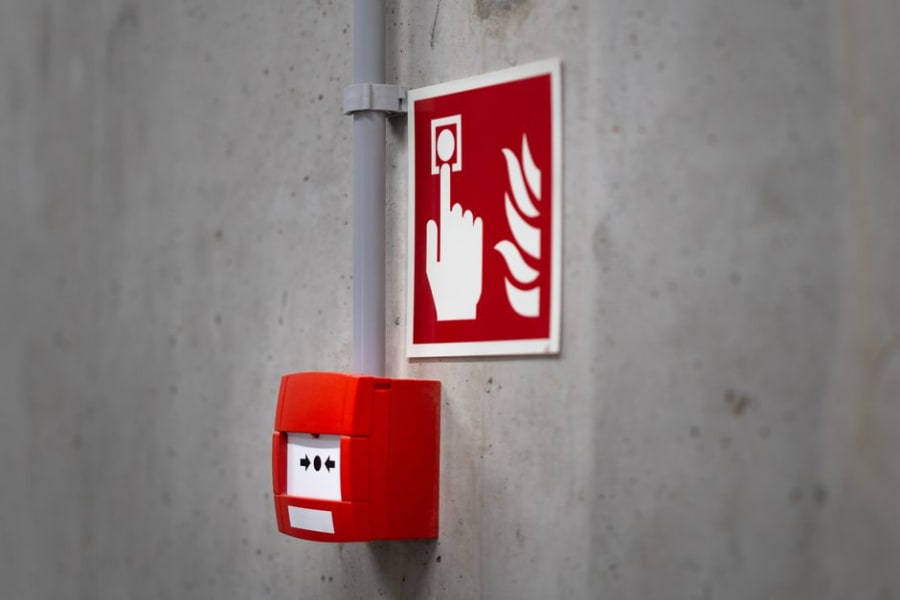
Category M is a manual system - break-glass call points and sounders, no automatic detection. Someone has to spot the fire and raise the alarm. Category L systems are for protecting life, and they run from L1 down to L5. L1 means automatic detection throughout the entire building, giving the earliest possible warning. L2 and L3 protect escape routes plus specific higher-risk rooms, L4 covers escape routes only, and L5 is a custom category for a defined risk. Category P systems exist to protect property rather than life, usually to satisfy an insurer - P1 covers the whole building, P2 covers defined areas. Most Bristol commercial premises end up with an L-category system, sometimes combined with property protection where an insurer requires it.
Which System Your Bristol Premises Actually Needs
The right category comes out of the fire risk assessment, but the building type points you in the right direction. A Bristol hospitality venue - the bars and restaurants around King Street, Wapping Wharf or Gloucester Road - typically needs a proper L1 or L2 system because you have members of the public who do not know the building, often in low light, sometimes after a drink. A standard office in the Temple Quarter might be well served by an L3 or L4 system focused on escape routes. Retail units around Broadmead and Cabot Circus vary with size and layout.

Houses in multiple occupation and mixed-use buildings, of which Bristol has a great many, carry their own requirements and often need whole-building coverage. The honest answer for any specific premises is that the assessment decides, but a system that is under-specified for the building is a false economy that an inspection will flag. When we quote fire alarm work as part of our inspection, certification and compliance service, the category is always tied back to the assessment, not guessed.
Conventional vs Addressable Systems
Beyond the category, there is a choice of technology, and it matters for larger buildings. A conventional system divides the building into zones and tells you which zone a fire is in - fine for a small premises with a handful of areas. When the panel shows an alarm, you know it is somewhere in, say, zone three, and you go and look.

An addressable system gives every detector and call point its own identity, so the panel tells you exactly which device has triggered - “kitchen extract, second floor” rather than “zone three”. In a large or multi-storey Bristol building that precision saves critical minutes and makes false alarms far easier to investigate and clear. Addressable systems cost more up front but are usually the sensible choice above a certain size, and they are easier to maintain and expand. For a small shop or office, a well-designed conventional system is often all you need.
Installation, Zoning and Design
A fire alarm is only as good as its design and installation. Detectors have to be the right type for each area - optical smoke detectors for general spaces, heat detectors for kitchens and dusty areas where smoke detectors would false-alarm, and the correct spacing and coverage throughout. Call points go on escape routes and at final exits so anyone leaving can raise the alarm on the way out. Sounders have to be loud enough to be heard everywhere, including over machinery in a workshop or music in a bar.

Zoning matters too: the building is divided so that a fire can be located quickly, with zone boundaries that make sense for how people move through the building. All of this is set out in BS 5839, and a system installed by someone who does not work to it is worse than useless because it breeds false confidence. This is skilled commercial wiring and installation work, and cutting corners on it is not something any Bristol business should accept.
Testing, Maintenance and Certification
Installing the system is the start, not the end. Under the fire safety order the system has to be maintained, which means a weekly test of a different call point by the responsible person and a full service by a competent engineer at least every six months. Records must be kept and produced on request. Third-party certification through a scheme such as BAFE is a strong sign that a fire alarm company works to the proper standards, and many insurers look for it.

We cover the testing and maintenance side in detail in our guide to emergency lighting and fire alarm testing for Bristol businesses, which sets out exactly what has to be done and how often. The short version is that a fire alarm is a living system - batteries fail, detectors get dusty, buildings change use - and it needs looking after to stay reliable.
What a Commercial Fire Alarm Costs in Bristol
Cost tracks the category, the size of the building and the number of devices. A small conventional Category M or L system for a single-unit shop or office in Bristol starts in the low thousands. A larger addressable L2 or L1 system across a multi-storey building, with dozens of detectors, multiple sounders and an addressable panel, runs well into five figures. Retrofitting into an older building where cable has to be run carefully around existing structure costs more than a straightforward new-build install.

The way to get a real number is a survey against your fire risk assessment, not a price over the phone. An engineer looks at the building, the use, the escape routes and the assessment, then specifies the category and designs the system to suit. That survey also picks up anything non-compliant in the existing setup. Spending a little on getting the specification right is far cheaper than installing the wrong system and having an inspection tell you to do it again.
Frequently Asked Questions
Is a fire alarm a legal requirement for my Bristol business?
You must have an appropriate means of detecting and warning people of a fire, but the law does not name a specific system. The Regulatory Reform (Fire Safety) Order 2005 requires the responsible person to carry out a fire risk assessment and put suitable fire detection and warning in place. For most commercial premises above the very smallest that means a BS 5839 fire alarm system, and the risk assessment determines which category.
Who is the responsible person for fire safety in a commercial building?
It is usually the employer, the owner, the landlord, or whoever has control of the premises. In a shared building there can be more than one responsible person. That person is legally accountable for the fire risk assessment and for making sure detection, warning and escape provisions are suitable and maintained.
How often does a commercial fire alarm need testing in Bristol?
A different call point should be tested weekly by the responsible person, and the whole system should be serviced by a competent engineer at least every six months. Records must be kept. Weekly tests take minutes, the six-monthly service is a proper inspection of panel, detectors, call points and batteries.
What does a commercial fire alarm system cost in Bristol?
It depends on the category, the size of the building and the number of devices. A small conventional system for a shop or office starts in the low thousands, while a large addressable Category L1 system across a multi-storey building runs to tens of thousands. A site survey against your fire risk assessment gives an accurate figure.
Get a free quote from Bristol Commercial Electricians for fire alarm installation, testing and compliance across Bristol and the surrounding area.